Materials estimating guide
How Many Pavers Do I Need? Pieces per Square Foot by Size
How many pavers do you need? Divide 144 by the paver's face area in square inches for pieces per sq ft, multiply by the patio area, then add waste for cuts.
Published 2026-09-19 · Updated 2026-09-19 · BuildMeasure Editorial Team
Next step
Turn your measurements into a material estimate
Enter the recorded dimensions in the calculator. It shows the calculated amount, wastage allowance, and a supplier-ready suggested order.
Use the Paver CalculatorHow many pavers do I need? The quick formula
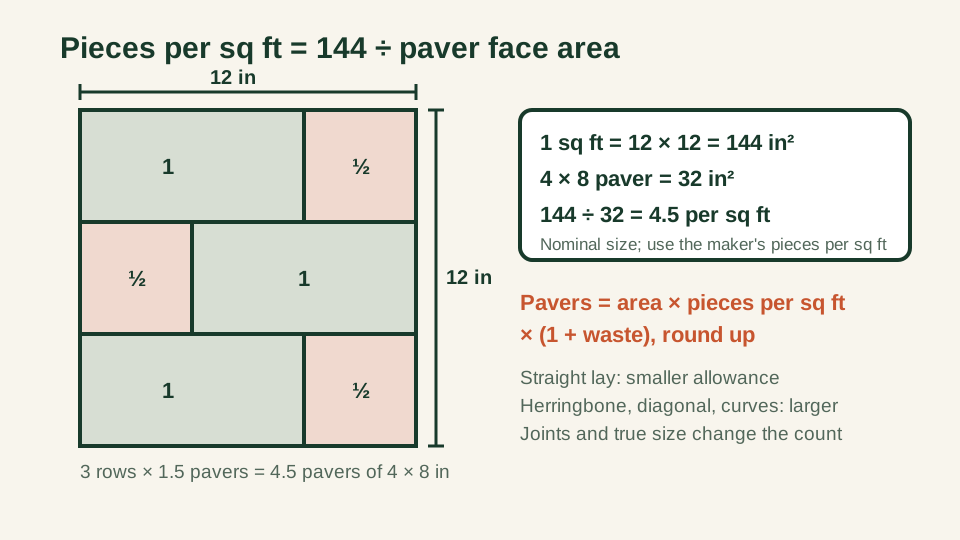
How many pavers you need: find pieces per square foot (144 ÷ the paver's length × width in inches), multiply by patio square feet, add a waste allowance for cuts, and round up. For 4 × 8 in pavers that is 144 ÷ 32 = 4.5 per square foot, so a 12 × 12 ft patio needs 648 before waste.
Two refinements make the count match what you actually buy. First, use the manufacturer's published pieces-per-square-foot figure when there is one, because real pavers are slightly smaller than their nominal size and sit with joints between them. Second, size the waste allowance to the laying pattern — straight patterns cut far fewer pieces than herringbone or curves.
- Pieces per sq ft = 144 ÷ (paver length in × paver width in).
- Pavers = patio sq ft × pieces per sq ft × (1 + waste %), rounded up.
- Pallets or bundles = pavers ÷ pieces per pallet, rounded up (or buy the remainder loose if the yard allows).
How many pavers per square foot, by size
The table uses nominal sizes and simple area arithmetic: a square foot is 12 × 12 = 144 square inches, so pieces per square foot is 144 divided by the paver's face area. Use it for a first estimate, then replace the pieces-per-square-foot figure with the one on your product's spec sheet.
| Paver (in) | Face area (in²) | Pieces per sq ft | Sq ft per piece | Per 100 sq ft | 12 × 12 ft patio (144 sq ft) |
|---|---|---|---|---|---|
| 4 × 8 | 32 | 4.5 | 0.222 | 450 | 648 |
| 6 × 6 | 36 | 4.0 | 0.250 | 400 | 576 |
| 6 × 9 | 54 | 2.67 | 0.375 | 267 (266.7) | 384 |
| 12 × 12 | 144 | 1.0 | 1.000 | 100 | 144 |
| 16 × 16 | 256 | 0.5625 | 1.778 | 57 (56.25) | 81 |
| 24 × 24 | 576 | 0.25 | 4.000 | 25 | 36 |
Nominal sizes, no joints, no waste. Fractional counts rounded up to whole pavers. Add your waste allowance after this step.
Why the maker's number differs from 144 ÷ size
A '4 × 8' paver is a nominal size. Unilock's Hollandstone cut sheet, for example, lists the paver as 4 × 8 × 2⅜ in (100 × 200 × 60 mm) with 'all measurements nominal', and its product sheet gives the actual face as 3⅞ × 7⅞ in — and the same cut sheet publishes 4.58 units per square foot.
The three numbers tell the story. Nominal: 144 ÷ (4 × 8) = 4.5. Actual face with the pavers butted tight: 144 ÷ (3.875 × 7.875) = 144 ÷ 30.52 = 4.72. Published, which allows for the joints between pavers: 4.58. Joints make each paver occupy slightly more than its face, so the published count sits between the two.
That is why the published figure is the one to use when you have it. For square slabs such as '16 × 16' patio stones, check the listed actual size too: if the real face is smaller than 16 in, you need slightly more pieces than the nominal 0.5625 per square foot.
How many pavers are on a pallet?
There is no standard pallet. Coverage depends on the paver's size and thickness and on how the manufacturer bundles it, so read the square feet and pieces per pallet (or 'bundle' or 'cube') on the product listing.
Two published examples for a 60 mm (2⅜ in) Holland-style 4 × 8 paver show the spread: Unilock's Hollandstone cut sheet lists 500 units and 109.26 sq ft per bundle, while Cummin Landscape Supply lists its Holland Stone 60 mm at approximately 120 sq ft and approximately 3,120 lb per pallet.
Divide your paver count (with waste) by the pieces per pallet and round up. If the remainder is small, ask whether the yard sells partial pallets or loose pieces — and buy everything from the same order so the colour matches.
Waste allowance: straight patterns vs herringbone and curves
Every edge where a paver meets a border, step or curve needs cuts, and a cut paver's offcut often cannot be used elsewhere. Lowe's DIY paver installation sheet recommends buying 5 percent more product than estimated to account for cutting and breakage.
Treat 5% as the floor for a simple rectangle in a straight or running-bond pattern, and consider nearer 10% if you also want spare pavers for future repairs. Herringbone laid at 45°, diagonal patterns and curved borders cut far more pieces; estimators commonly plan around 15% for those. That higher range is an estimating convention, not a manufacturer figure — confirm it with your installer or supplier for your layout.
- Straight or running bond, rectangular area: 5% (Lowe's recommendation) to about 10% with repair spares.
- Herringbone, diagonal or curved edges: plan a larger allowance, commonly around 15%.
- Many borders, steps or cut-outs: count the cut edges and add more, not less.
Worked example: a 12 × 12 ft patio with 4 × 8 pavers
Area: 12 × 12 = 144 sq ft.
Nominal count: 144 ÷ 32 = 4.5 pieces per sq ft. 144 × 4.5 = 648 pavers before waste.
Maker's count: Unilock publishes 4.58 units per sq ft for Hollandstone. 144 × 4.58 = 659.52, rounded up to 660 pavers.
Waste: running bond with 5%: 660 × 1.05 = 693 pavers. For a 45° herringbone at 15%: 660 × 1.15 = 759 pavers.
Bundles: at 500 pieces per bundle, 693 ÷ 500 = 1.386, so two bundles if the yard sells only whole bundles (1,000 pieces, 307 spare) — or one bundle plus 193 loose pieces. Cross-check by area: 144 × 1.05 = 151.2 sq ft ÷ 109.26 sq ft per bundle = 1.38 bundles.
Grid check: the Paver Calculator counts whole rows along each edge instead of dividing area. With a 3⅞ × 7⅞ in face and a 1/16 in joint, 144 in ÷ 7.9375 in = 18.14, so 19 rows one way, and 144 ÷ 3.9375 = 36.57, so 37 the other way: 19 × 37 = 703 pavers before waste. The grid count is higher because the last row on two edges is a cut row that still uses whole pavers.
- Patio measured in feet; area = length × width (split L-shapes into rectangles).
- Pieces per sq ft taken from the product sheet, or 144 ÷ nominal face area for a first estimate.
- Waste allowance matched to the pattern and number of cut edges.
- Total rounded up to whole pavers, then to pallets or bundles.
- Base and bedding sand calculated separately over the wider excavation.
Common questions
Quick answers using the formula above. Replace nominal figures with your product's published pieces per square foot.
- How many pavers per square foot? — 144 ÷ the paver's face area in square inches: 4.5 for 4 × 8, 4 for 6 × 6, 2.67 for 6 × 9, 1 for 12 × 12, 0.5625 for 16 × 16 and 0.25 for 24 × 24. Unilock's published figure for its 4 × 8 Hollandstone is 4.58, because of true size and joints.
- How many pavers for a 12x12 patio? — 144 sq ft × 4.5 = 648 nominal 4 × 8 pavers; using Unilock's 4.58 per sq ft and 5% waste, 693.
- How many 16x16 pavers do I need? — 0.5625 per sq ft: a 12 × 12 ft patio is exactly 9 × 9 = 81 pavers, and 100 sq ft is 56.25, so 57, before waste. Check the listed actual size — a smaller real face means slightly more pieces.
- How many pavers are on a pallet? — It varies by product: Unilock lists 500 Hollandstone units (109.26 sq ft) per bundle; Cummin Landscape Supply lists its Holland Stone 60 mm at approximately 120 sq ft per pallet. Read the listing for your paver.
- Is there a 'how many pavers do I need' calculator? — Yes: the Paver Calculator counts rows from the installed paver size and joint width, adds your waste allowance, and keeps the crushed-stone base and bedding sand as separate lines.
What this guide does not cover
This page counts the pavers. The crushed-stone base and bedding sand are separate materials measured over a wider excavation footprint — see the paver patio base guide. Paver thickness for driveways, base depth and edge restraint are set by the paver manufacturer's installation instructions and your plan.
Same project
Related measurement guides
Sources and limits
Check the project-specific details
- Unilock — Hollandstone & Double Holland cut sheet (PDF) — Lists Hollandstone as 4 × 8 × 2⅜ in (100 × 200 × 60 mm), 'all measurements nominal', 4.58 units per sq ft, and 500 units / 109.26 sq ft per 60 mm bundle; Double Holland 8 × 8 at 2.30 units per sq ft.
- Unilock — Hollandstone product sheet (PDF) — Gives the imperial dimension of the nominal 4 × 8 Hollandstone as 3⅞ × 7⅞ × 2⅜ in and repeats 4.58 units per sq ft — the basis for the nominal vs actual vs published comparison.
- Lowe's — DIY Paver Patio and Walkway Installation (PDF) — Paver count worksheet dividing project square inches by 144 and multiplying by 1.05, with the note that it is recommended to purchase 5 percent more product than estimated to account for cutting and breakage.
- Cummin Landscape Supply — Holland Stone 60mm — Supplier listing for a 4 × 8 × 2⅜ in Holland Stone paver sold by the pallet at approximately 120 sq ft and approximately 3,120 lb per pallet — a second pallet-coverage example.
Review status: Formulas and worked examples checked by hand; measurement practice pending human trade review.
This guide supports planning only. It does not specify structural design, code compliance, or a supplier quotation.