Concrete planning guide
How Much Concrete for Steps
Estimate concrete for solid poured steps by stacking each step as a rectangular prism from rise, run, width, and step count. Hollow or fill-backed steps use less.
Published 2026-07-20 · Updated 2026-07-20 · BuildMeasure Editorial Team
Next step
Turn your measurements into a material estimate
Enter the recorded dimensions in the calculator. It shows the calculated amount, wastage allowance, and a supplier-ready suggested order.
Use the Concrete Volume CalculatorSolid steps are a stack of rectangular prisms
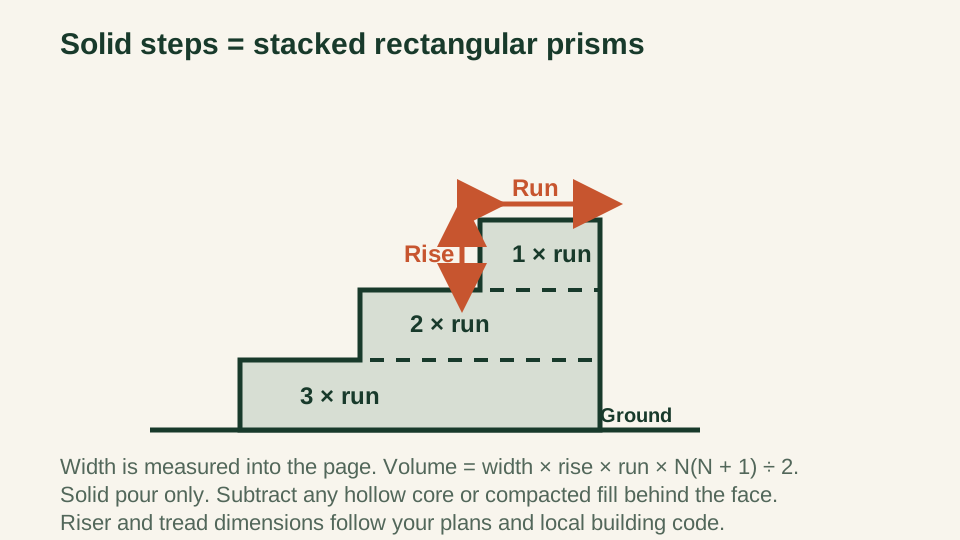
A flight of solid poured steps is not one simple shape, but it breaks cleanly into rectangular prisms. Picture each step as a block that runs all the way back to the ground: the bottom step is the deepest block, the next one sits on top and is one tread shorter, and so on up to the top step.
Because every block is a rectangle — width × depth × height — you can measure a staircase with three numbers and a count: the rise (the height of one step), the run (the depth of one tread), the width, and the number of steps.
This guide covers solid steps only. If your steps are hollow, formed as a shell, or poured over compacted fill, they hold less concrete — see the scope note below before you order.
The stacked-prism formula, step by step
Number the steps from the top down. The top step is one block: width × run × rise. The second step is a block two treads deep: width × (2 × run) × rise. The third is three treads deep, and so on. Add the blocks together.
That sum has a shortcut. Adding 1 + 2 + 3 and so on up to the number of steps N equals N × (N + 1) ÷ 2, so the whole flight is: Volume = width × run × rise × N × (N + 1) ÷ 2. Convert width, run, and rise to feet first (divide inches by 12), then divide the result by 27 for cubic yards.
The stacked-prism method is deliberately generous: it treats the flight as a solid mass, which is the safe assumption when you would rather have a little extra than run short on the top steps.
What this estimate excludes: hollow cores and fill
Many exterior steps are not solid. A common build pours a concrete shell — a face and treads a few inches thick — over a core of compacted gravel or soil, which uses far less concrete than a solid block. Precast, block-built, and rendered steps are hollow or filled by design.
If your steps have a fill core or a hollow back, estimate the solid volume first, then subtract the fill or void as its own rectangular block. This guide does not size the fill, the reinforcement, or the structural design of the steps; riser and tread dimensions and any code requirements come from your plans and local building authority.
Add a landing as its own rectangular prism
A landing or top platform is a flat slab: length × width × thickness. Calculate it separately and add it to the stair volume. Do not fold it into the rise-and-run formula, which only describes the stepped section.
The same applies to cheek walls or side walls beside the steps — each is a separate rectangular or triangular volume, measured and added on its own.
Worked example: three 36-inch-wide steps
Three solid steps, each with a 7-inch rise and an 11-inch run (tread depth), 36 inches wide. The table stacks the three prisms, each one tread deeper than the step above it.
The three blocks total 16,632 cubic inches. Divide by 1,728 to get 9.63 cubic feet, then by 27 to get 0.36 cubic yards; a 10% waste allowance brings it to about 0.39, which rounds up to 0.5 cubic yards. A 36 in × 36 in × 4 in landing on top would add 5,184 cubic inches (3.0 cubic feet), calculated separately.
| Step | Depth to ground (in) | Rise (in) | Width (in) | Volume (cu in) |
|---|---|---|---|---|
| Bottom | 33 | 7 | 36 | 8,316 |
| Middle | 22 | 7 | 36 | 5,544 |
| Top | 11 | 7 | 36 | 2,772 |
| Total | — | — | — | 16,632 |
Depth to ground is the number of treads at and below that step, times the run. The total also equals 36 × 11 × 7 × 3 × 4 ÷ 2 = 16,632 cu in. Divide by 1,728 for cubic feet.
Measurement checklist
Record these before you calculate, and decide up front whether the steps are solid or built over fill.
- Rise of one step in inches (all steps should share the same rise).
- Run — the tread depth — of one step in inches.
- Width of the steps in inches, measured across the treads.
- Number of steps in the flight.
- Whether the steps are solid, hollow, or poured over compacted fill.
- Fill or void volume to subtract, if the steps are not solid.
- Landing dimensions (length × width × thickness), calculated as a separate slab.
- Waste allowance, added after the stair and landing volumes are totalled.
Same project
Related measurement guides
Sources and limits
Check the project-specific details
- NIST unit conversion reference — Reference for the exact inch, foot, and cubic yard definitions used in the conversions.
- Portland Cement Association — General guidance on concrete flatwork and steps; step design and reinforcement require qualified review.
Review status: Formulas and conversions covered by automated tests; measurement practice pending human trade review.
This guide supports planning only. It does not specify structural design, code compliance, or a supplier quotation.