Paint planning guide
How Much Does a Gallon of Paint Cover?
A gallon covers about 350–400 sq ft per coat on the label, but far less on the wall once you count two coats, surface texture, and whole-can rounding.
Published 2026-07-20 · Updated 2026-07-20 · BuildMeasure Editorial Team
Next step
Turn your measurements into a material estimate
Enter the recorded dimensions in the calculator. It shows the calculated amount, wastage allowance, and a supplier-ready suggested order.
Use the Paint CalculatorThe short answer: about 350–400 sq ft per coat on the label
A US gallon of interior wall paint covers roughly 350 to 400 square feet in one coat on a smooth, sealed, previously painted wall — the figure most labels print, though some brands state a wider 250 to 400 range. On the wall, a gallon paints much less than that number suggests, because the label figure is a single-coat, best-case spreading rate, while real projects use two coats over textured or porous surfaces and round up to whole cans.
So the honest answer has two numbers: the label coverage — what a gallon spreads to at the ideal film thickness — and the net project coverage — what a gallon actually paints on your walls. This guide separates them and shows the arithmetic for each.
Where the label number comes from: one gallon, one mil, 1,604 sq ft
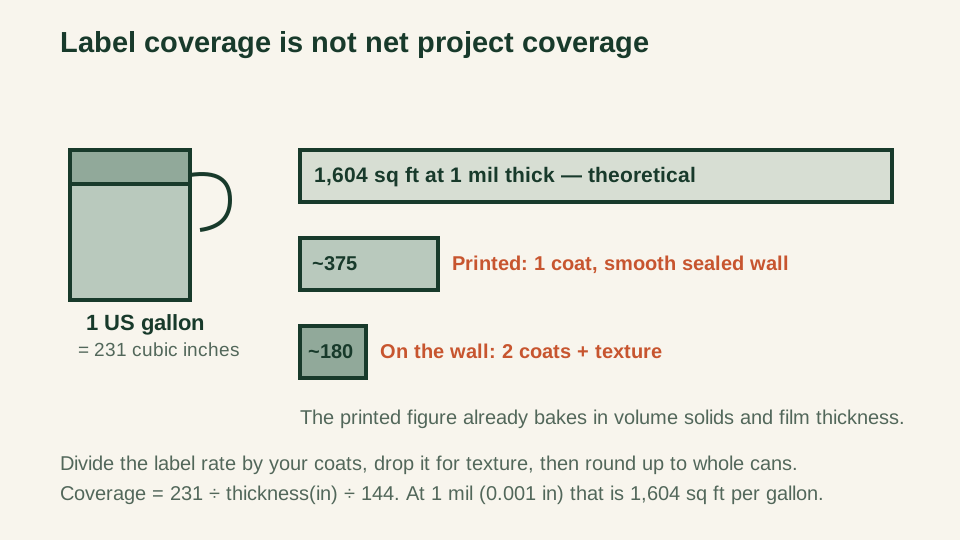
A US gallon is 231 cubic inches by definition. Spread that gallon in a film one mil thick (one thousandth of an inch) and it covers 231 ÷ 0.001 = 231,000 square inches, which is 231,000 ÷ 144 = 1,604 square feet. That is the theoretical coverage of a gallon at one mil — the physical ceiling, before any real-world loss.
Paint is not applied one mil thick, and it is not pure solids. The printed 350 to 400 square feet already accounts for the product's volume solids — the share that stays on the wall after the water or solvent leaves — and the film thickness needed to hide and wear properly. That is why the printed figure is a small fraction of the 1,604 theoretical maximum.
| Product (printed figure) | Coverage per gallon | Conditions behind the number |
|---|---|---|
| Typical interior latex, per coat | 350–400 sq ft | About 4 mils wet, smooth sealed wall, no application loss |
| Behr paints (coverage guidance) | 250–400 sq ft | Behr's stated range across its lines; rough or porous surfaces use more |
| Benjamin Moore Advance enamel | 400–500 sq ft | Trim and cabinet enamel applied in thin coats |
These are the manufacturers' own printed values; the figure on the can you buy governs your estimate.
Label coverage is a theoretical spreading rate
Manufacturer data pages call the printed number a spreading rate and state plainly that it is calculated from volume solids and does not include application loss. It assumes one coat, an even film at the rated thickness, and a smooth, sealed surface. It is the most a gallon can cover under laboratory conditions — not a promise for your room.
Three things on a real job pull the number down: the surface, the applicator, and the coats. Texture and porosity drink paint; rollers and brushes leave paint in the tray, the sleeve, and the cut-in; and almost every finish needs two coats. Each of these is a separate reduction applied to the label rate.
Net project coverage: what a gallon actually paints
Net coverage is the label rate reduced for coats, surface, and rounding. The single biggest factor is coats: two coats halves the wall area a gallon can paint, because the same paint is spread over the same wall twice. A gallon rated at 400 square feet per coat paints only about 200 square feet of wall at two coats.
Then trim for the surface — a textured or porous wall can take 10 to 20 percent more paint — and round up to whole cans, because you cannot buy 2.2 gallons. The net figure is the one that tells you how many cans to carry home.
Two coats halves your coverage: a worked example
Take a wall area of 1,000 square feet and a paint the label rates at 400 square feet per gallon. For one coat, 1,000 ÷ 400 = 2.5 gallons. For the standard two coats, 1,000 × 2 = 2,000 square feet to cover, and 2,000 ÷ 400 = 5 gallons.
Turn that around and the net coverage is clear: 5 gallons painted 1,000 square feet of wall, so each gallon netted 1,000 ÷ 5 = 200 square feet of finished, two-coat wall — half the 400 on the label, before any texture penalty or can rounding.
| Situation | What one gallon paints |
|---|---|
| One coat, smooth sealed wall | ~350–400 sq ft |
| Two coats, smooth wall | ~175–200 sq ft |
| Two coats, textured or porous | ~150–180 sq ft |
| Bare drywall (soaks the first coat) | Less — prime first, then two coats |
Each row divides the label rate by the coats and trims for surface; use your can's rate in place of 400.
Worked example: how far two gallons really go
You buy two gallons of a paint rated at 375 square feet per gallon and plan two coats on a lightly textured wall. Two gallons give 2 × 375 = 750 square feet of single-coat capacity.
Two coats halve the wall you can cover: 750 ÷ 2 = 375 square feet. The light texture takes roughly 10 percent more paint, so divide by 1.1: about 375 ÷ 1.1 ≈ 341 square feet of finished wall from two gallons — not the 750 the label capacity might suggest. If the room needs more, round up and buy the next can.
Common coverage mistakes
Almost every coverage surprise traces back to treating the single-coat label rate as the finished answer.
- Reading the label figure as a two-coat number — it is per coat, so two coats need twice the paint.
- Using the best-case rate on textured, porous, or bare surfaces that drink more paint.
- Forgetting application loss — paint left in the tray, roller, and brush never reaches the wall.
- Buying the exact computed gallons with nothing rounded up and no touch-up can kept.
- Comparing coverage across products without checking each can — enamels, primers, and flats differ.
Same project
Related measurement guides
Sources and limits
Check the project-specific details
- NIST Handbook 44 (2026), Appendix C: General Tables of Units of Measurement — U.S. customary volume table giving 1 US gallon = 231 cubic inches, the basis for the one-gallon-at-one-mil coverage of 1,604 sq ft.
- Sherwin-Williams product data sheets (paintdocs.com) — Product data pages state the recommended spreading rate per coat and note it is calculated on volume solids and does not include application loss.
- Behr: how much paint to buy — Manufacturer guidance stating one gallon of Behr paint covers 250–400 sq ft in one coat, depending on surface texture and porosity.
Review status: Formulas and conversions covered by automated tests; measurement practice pending human trade review.
This guide supports planning only. It does not specify structural design, code compliance, or a supplier quotation.