Paint planning guide
How Much Paint for a House Exterior
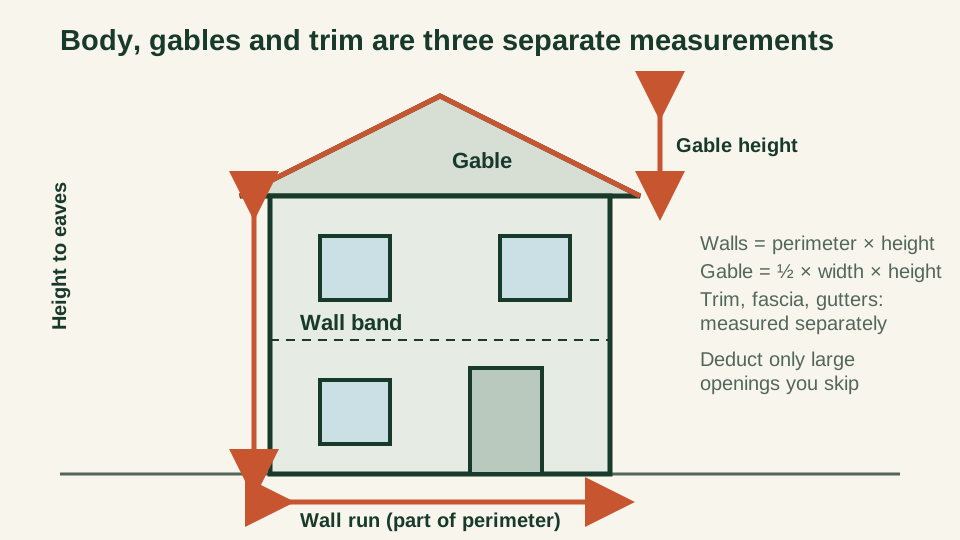
Measure the body as perimeter times height to the eaves, add each gable triangle, deduct only large openings, and paint trim as a separate calculation.
Published 2026-07-20 · Updated 2026-07-20 · BuildMeasure Editorial Team
Next step
Turn your measurements into a material estimate
Enter the recorded dimensions in the calculator. It shows the calculated amount, wastage allowance, and a supplier-ready suggested order.
Use the Paint CalculatorThe short answer: body, gables, and trim are three take-offs
To estimate exterior paint, measure the body of the house as wall area — the perimeter multiplied by the height to the eaves — then add each gable as a triangle on top of that, and subtract only the large openings you are not painting. Take the coverage figure off your paint can, multiply the area by the number of coats, and divide.
The three take-offs do not mix. Body paint, trim enamel, and any gable or accent color are measured and bought on their own, because each covers a different area and usually uses a different product and sheen. Run the body through the calculator once, then run the trim through it again as a separate job.
Measure the walls as bands: perimeter × height to the eaves
Walk the house and measure the length of each exterior wall at ground level, then add them for the perimeter. Multiply the perimeter by the wall height from the foundation to the eaves — the underside of the roof overhang. That product is the gross wall area of the body.
For a two-story house, measure the full height from the foundation to the eaves in one number, or measure each story and add them. Measure to the eaves, not to the roof peak: the triangle above the eaves is the gable, handled next.
- Perimeter = the sum of every exterior wall length at ground level.
- Body wall area = perimeter × height from the foundation to the eaves.
- Add bump-outs, bay windows, and wing walls as their own extra bands.
Add each gable as a triangle, not a rectangle
A gable is the triangular wall between the eaves line and the roof ridge on a gable-end wall. Its area is one half of the base times the height: ½ × gable width × gable height. Measure the width along the eaves and the height from the eaves line up to the ridge.
Add one triangle for each gable end. A simple gable roof has two; a more complex roof can carry several dormers and gablets, each its own small triangle. A hip roof has no gable ends, so there is nothing to add above the eaves on those walls.
Deduct only the large openings you are not painting
Subtract the area of large openings that get no paint — garage doors, picture windows, sliding-glass walls, and the like. Measure each as width × height and take it off the gross area. Leave ordinary windows and doors in the wall area: the paint cuts in around them, and the small saving is a useful safety margin.
Keep openings separate from trim. Window and door casings, sills, and brickmould are trim, measured and painted in the trim take-off below — they are not deducted from the body area and not folded into it.
Coverage drops on texture — take the number off the can
Exterior coverage depends on the siding. A gallon spreads farthest on smooth, sound, previously painted siding, and covers far less on rough-sawn wood, shakes, stucco, or masonry, where paint sinks into the texture. Take the coverage figure from the can or data sheet of the product you buy, not a generic number.
Manufacturer figures are best-case ranges. Behr's exterior paint guidance, for example, puts one gallon of its paint at 250 to 400 square feet in one coat, with porous, rough, textured, or previously unpainted surfaces using more paint and dramatic color changes needing extra coats. On textured siding, plan for the lower end of the printed range and for two coats over a color change or bare wood.
| Siding or surface | Effect on coverage per gallon | Typical coats |
|---|---|---|
| Smooth, previously painted lap siding | Near the label's best case | 1–2 |
| Rough-sawn wood or shakes | Lower — paint fills the texture | 2 |
| Stucco or rough masonry | Much lower — deep texture | 2 |
| Bare or new wood, or a big color change | Lower, plus a primer coat | Primer + 2 |
Take the coverage figure from your product's can or data sheet; the values above only show the direction it moves.
Trim, fascia, gutters, and doors are their own paint
Trim is measured in linear feet and converted to area, then calculated as a separate product — usually a harder exterior enamel in a different sheen. Measure the running length of fascia, rake boards, corner boards, and window and door casings, and multiply each by its face width in feet to get area.
Doors painted in an accent color, shutters, gutters, and downspouts are each their own small take-off. A little math here prevents the classic mistake of buying body paint for the trim, or running out of trim enamel halfway around the house.
- Fascia and rake boards: linear feet × face width in feet.
- Corner boards and window or door casing: linear feet × face width.
- Accent doors, shutters, gutters, downspouts: counted and estimated per their own product.
Worked example: a two-story 30 × 40 ft house with two gables
Take a two-story house with a 30 ft × 40 ft footprint, 18 ft from the foundation to the eaves, and a gable end on each 30 ft wall rising 8 ft to the ridge.
Perimeter = 2 × (30 + 40) = 140 ft. Body wall area = 140 × 18 = 2,520 sq ft. Gables = 2 × (½ × 30 × 8) = 240 sq ft. Gross body = 2,520 + 240 = 2,760 sq ft.
Deduct a 16 ft × 7 ft garage door (112 sq ft) and an 8 ft × 5 ft picture window (40 sq ft): 2,760 − 152 = 2,608 sq ft of body to paint. Two coats: 2,608 × 2 = 5,216 sq ft to cover.
At 350 sq ft per gallon on lightly textured siding, 5,216 ÷ 350 = 14.9 → 15 gallons of body paint. If your can and surface give the full 400, it is 5,216 ÷ 400 = 13.04 → 14 gallons. Round up to whole cans or 5-gallon pails, and calculate the trim enamel separately.
| Element | Dimensions | Area (sq ft) |
|---|---|---|
| Wall band | 140 ft perimeter × 18 ft | 2,520 |
| Gable ends (×2) | ½ × 30 ft × 8 ft each | 240 |
| Garage door (deduct) | 16 ft × 7 ft | −112 |
| Picture window (deduct) | 8 ft × 5 ft | −40 |
| Net body area | — | 2,608 |
Two coats = 2,608 × 2 = 5,216 sq ft to cover; at 350 sq ft per gallon that is 15 gallons. Trim is a separate take-off.
Whole-house exterior take-off checklist
Walk the house once and capture every item below before you price paint. With these numbers written down, the body and the trim are each a one-minute calculation.
- Perimeter measured from every exterior wall length at ground level.
- Height to the eaves measured, or each story added, including bump-outs and bays.
- Each gable measured as ½ × width × height and added on top of the wall bands.
- Large unpainted openings (garage doors, picture windows) measured and deducted.
- Coverage figure read from the actual product can or data sheet.
- Coats decided: two over a color change or bare wood, plus primer where needed.
- Trim, fascia, gutters, and accent doors measured as separate take-offs.
- Body and trim rounded up to whole cans or pails, with a labelled touch-up can kept.
Same project
Related measurement guides
Sources and limits
Check the project-specific details
- Behr: How much exterior paint do I need? — Manufacturer guidance stating one gallon covers 250–400 sq ft in one coat and that rough, porous, or unpainted surfaces need more paint; use your own can's figure.
- NIST Handbook 44 (2026), Appendix C: General Tables of Units of Measurement — U.S. customary area units behind the perimeter, wall-band, and gable-triangle arithmetic.
- EPA Renovation, Repair and Painting Program — Scraping or sanding exterior paint on homes built before 1978 may require lead-safe work practices.
Review status: Formulas and conversions covered by automated tests; measurement practice pending human trade review.
This guide supports planning only. It does not specify structural design, code compliance, or a supplier quotation.