Paint planning guide
How Much Paint for Kitchen Cabinets
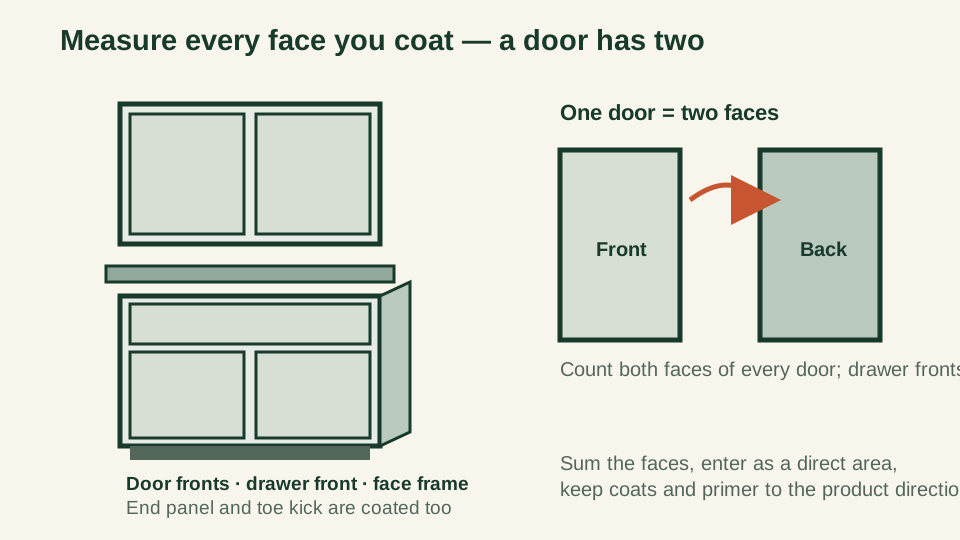
Measure every face you will coat, count both faces of each door, enter it as a direct area, and keep coats and primer to the product's directions.
Published 2026-07-20 · Updated 2026-07-20 · BuildMeasure Editorial Team
Next step
Turn your measurements into a material estimate
Enter the recorded dimensions in the calculator. It shows the calculated amount, wastage allowance, and a supplier-ready suggested order.
Use the Paint CalculatorThe short answer: measure every face, count both sides of doors
To estimate cabinet paint, measure every surface you will coat — door fronts and backs, drawer fronts, the face frames, and any exposed end panels — add them into one area, and enter that as a direct area in the calculator. Then follow your paint's directions for primer and coats. Cabinets are small in area but high in surface count, so the measuring, not the arithmetic, is where the number is won or lost.
The one rule that changes the total most: a cabinet door has two faces. If you paint the backs — and on most kitchens you do — every door counts twice.
The surfaces to measure
Cabinet painting scope is a set of separate faces, not a single wall. Decide which of these you are coating before you measure, and write down the count of each.
- Door fronts and backs — both faces of every door.
- Drawer fronts — the visible front face, adding the edges if they show.
- Face frames — the flat stiles and rails framing each opening.
- Exposed end and side panels — the finished sides of a run or an island.
- Toe kicks, plus any valances, corbels, or trim being painted.
- Cabinet interiors and shelves — only if you are coating them, which is optional.
How to measure each component
Measure each face as a simple rectangle in feet and multiply width by height. A door is width × height × 2 for both faces. A drawer front is width × height. For the face frame, measure the outside of the cabinet box front and subtract the door and drawer openings — what is left is the frame you paint.
Add the component areas into one total. Because the pieces are small, keep them in square feet and sum carefully; a dozen doors and their backs add up faster than people expect.
| Component | What to measure | Faces to count |
|---|---|---|
| Doors | Width × height of each door | Both faces (× 2) |
| Drawer fronts | Width × height of each front | Front (add edges if shown) |
| Face frames | Box front area minus the openings | One face |
| Exposed end/side panels | Width × height of each panel | One face |
| Toe kicks and trim | Length × height of each run | One face |
| Interiors and shelves | Shelf and interior area, if coated | As scoped (optional) |
Measure your own cabinets; door and drawer sizes vary widely between kitchens.
Coats: thin enamel, more of them
Cabinets are finished with a hard enamel applied in thin coats, and thin coats are the point — they level out and cure hard without sags. That means more coats than a wall: most cabinet jobs are a bonding primer plus two thin finish coats, and sometimes a third on doors that see wear.
Keep the coating system and its steps to the product directions. Benjamin Moore Advance, a waterborne alkyd the manufacturer lists for cabinets, doors, and trim, states coverage of 400 to 500 square feet per gallon, one or two coats, and a 16-hour recoat time; its directions call for sanding glossy surfaces first and allowing days of cure before returning doors to service. Follow the primer, coats, recoat, and cure figures printed for the exact product you buy — they are the manufacturer's, not ours.
Turning component areas into quarts and gallons
Sum every face into one total area, multiply by the number of finish coats, and divide by the label coverage of your enamel; round up to whole containers. Because thin cabinet coats spread less than the label's best case, plan the lower end of the coverage range. Run the primer as its own calculation at one coat and its own coverage.
Cabinet totals usually land in quarts, not gallons. That is normal — a typical kitchen is a hundred-odd square feet of surface, so a quart or two of enamel plus a quart of primer is often enough, with a little kept for touch-ups.
Worked example: a 12-door, 6-drawer kitchen
Suppose 12 doors averaging 15 in × 30 in, 6 drawer fronts at 15 in × 6 in, and about 40 square feet of face frames and two exposed end panels.
Doors: 15 in × 30 in = 1.25 ft × 2.5 ft = 3.125 sq ft per face, × 2 faces = 6.25 sq ft per door; 12 doors = 75 sq ft. Drawer fronts: 1.25 ft × 0.5 ft = 0.625 sq ft each; 6 ≈ 4 sq ft. Frames and end panels: about 40 sq ft. Total measurable area ≈ 75 + 4 + 40 = 119 sq ft.
Two finish coats: 119 × 2 = 238 sq ft to cover; at 400 sq ft per gallon that is 238 ÷ 400 = 0.6 gallon — about 3 quarts — of enamel. Primer at one coat, say 300 sq ft per gallon: 119 ÷ 300 = 0.4 gallon — about 2 quarts. Buy a little extra for a third coat on the doors.
| Item | Count | Area (sq ft) |
|---|---|---|
| Door fronts and backs | 12 doors × 2 faces | 75 |
| Drawer fronts | 6 | 4 |
| Face frames and end panels | — | 40 |
| Total measurable area | — | 119 |
Two coats = 238 sq ft to cover ≈ 3 quarts of enamel; primer at one coat ≈ 2 quarts. Round up and keep a touch-up container.
Cabinet paint take-off worksheet
Capture every line below at the cabinets, before you buy. The scope decisions and counts here are what turn into a short, correct shopping list of enamel and primer.
- Scope decided: which faces, and whether door backs and interiors are painted.
- Door count and average door size recorded, doubled for both faces.
- Drawer-front count and size recorded.
- Face-frame area taken as the box front minus the openings.
- Exposed end panels, toe kicks, and any painted trim measured.
- All faces summed into one total area for direct-area entry.
- Enamel coverage, coats, recoat, and cure read from the product data sheet.
- Primer calculated separately at one coat and its own coverage.
- Degrease and sanding steps noted from the product directions before any paint.
Same project
Related measurement guides
Sources and limits
Check the project-specific details
- Benjamin Moore Advance (waterborne alkyd) product information — Manufacturer page listing cabinets, doors, and trim, and stating 400–500 sq ft per gallon, one or two coats, and a 16-hour recoat; follow the data sheet for your product.
- NIST Handbook 44 (2026), Appendix C: General Tables of Units of Measurement — U.S. customary area units behind the component width × height take-off and the direct-area total.
- EPA Renovation, Repair and Painting Program — Sanding cabinets in homes built before 1978 may disturb lead-based paint and require lead-safe work practices.
Review status: Formulas and conversions covered by automated tests; measurement practice pending human trade review.
This guide supports planning only. It does not specify structural design, code compliance, or a supplier quotation.