Concrete planning guide
How to Calculate Concrete Slab Area (and Why It Isn't Volume)
Calculate concrete slab surface area as length times width, then see why thickness turns that area into the volume you actually order.
Published 2026-07-19 · Updated 2026-07-19 · BuildMeasure Editorial Team
Next step
Turn your measurements into a material estimate
Enter the recorded dimensions in the calculator. It shows the calculated amount, wastage allowance, and a supplier-ready suggested order.
Use the Concrete Slab CalculatorSlab area is length times width — nothing more
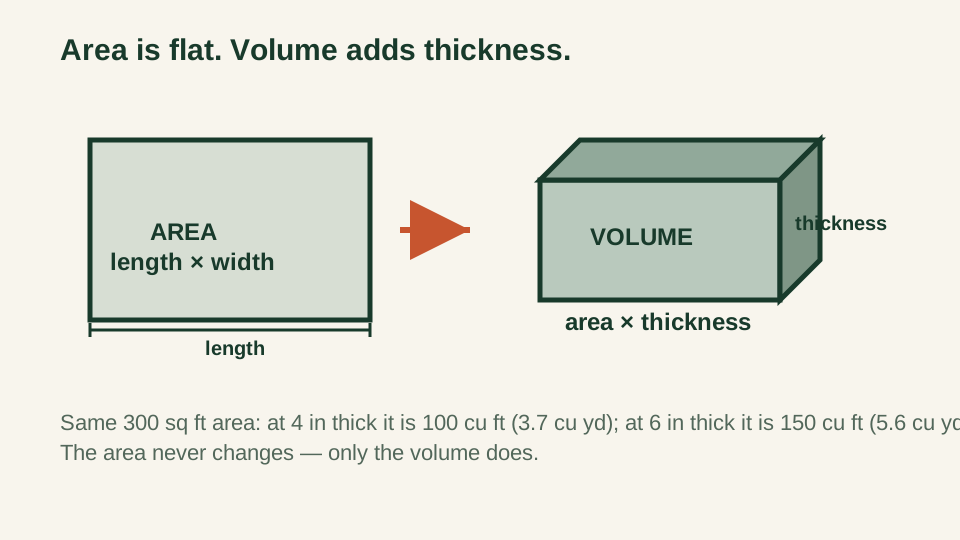
Concrete slab area is the flat surface measurement: length × width, in square feet. A 20 ft × 15 ft patio has a slab area of 300 sq ft. Area alone answers 'how big is the slab,' not 'how much concrete do I need' — that second question needs one more dimension.
Measure the inside length and width of the formed area at floor level, not the rough excavation. Keep both figures in feet so the multiplication is a single step.
Thickness turns a flat area into a volume
Thickness is a third dimension, not a percentage adjustment on top of area. Concrete volume = slab area × thickness, with thickness converted from inches to feet by dividing by 12. A 4-inch slab uses a thickness of 4 ÷ 12 = 0.333 ft in the multiplication.
The same 300 sq ft area needs a different volume depending on thickness: at 4 inches it is 300 × 0.333 = 100 cu ft (3.7 cu yd); at 6 inches it is 300 × 0.5 = 150 cu ft (5.6 cu yd). The area never changed — only the volume did.
Irregular slabs: find the area section by section, then apply thickness
For an L-shaped or notched slab, split the outline into rectangles, calculate each rectangle's area, and add them for the total slab area. Apply the slab thickness once, across the summed area, unless a section (such as a thickened edge) genuinely pours at a different depth.
See the irregular-slab guide for the full rectangle-decomposition method with a worked example.
Worked example: one area, two thicknesses
A 25 ft × 16 ft driveway pad has a slab area of 400 sq ft. Compare ordering it at a standard 4-inch residential thickness against a heavier 6-inch thickness for vehicle loading.
| Thickness | Volume formula | Cubic feet | Cubic yards |
|---|---|---|---|
| 4 in | 400 × (4 ÷ 12) | 133.3 | 4.94 |
| 6 in | 400 × (6 ÷ 12) | 200.0 | 7.41 |
Slab area stays 400 sq ft in both rows. Add your waste allowance to the cubic-yard figure before rounding to the supplier's order increment.
Before you calculate volume
Confirm these four figures before you open the slab calculator, so the area and the volume are never confused with each other.
- Slab length and width in feet, measured at the inside of the forms.
- Slab area (length × width) recorded on its own — this is a fixed number regardless of thickness.
- Thickness in inches, confirmed with your plans or contractor — do not guess or reduce it.
- Any sections (thickened edges, footings) that pour at a different thickness, measured and calculated separately.
Same project
Related measurement guides
Sources and limits
Check the project-specific details
- NIST unit conversion reference — Reference for exact foot and yard definitions used in area and volume conversions.
- Portland Cement Association slab design guide — Guidance distinguishing slab area, thickness, and placed volume for residential slabs.
Review status: Formulas and conversions covered by automated tests; measurement practice pending human trade review.
This guide supports planning only. It does not specify structural design, code compliance, or a supplier quotation.