Lawn planning guide
How Much Topsoil Do You Need for a Lawn?
Estimate topsoil for a new lawn, levelling, or thin top-dressing by area and spread depth, in cubic yards and per 1,000 sq ft, with settling as your input.
Published 2026-07-20 · Updated 2026-07-20 · BuildMeasure Editorial Team
Next step
Turn your measurements into a material estimate
Enter the recorded dimensions in the calculator. It shows the calculated amount, wastage allowance, and a supplier-ready suggested order.
Use the Topsoil CalculatorSpreading topsoil = area × spread depth
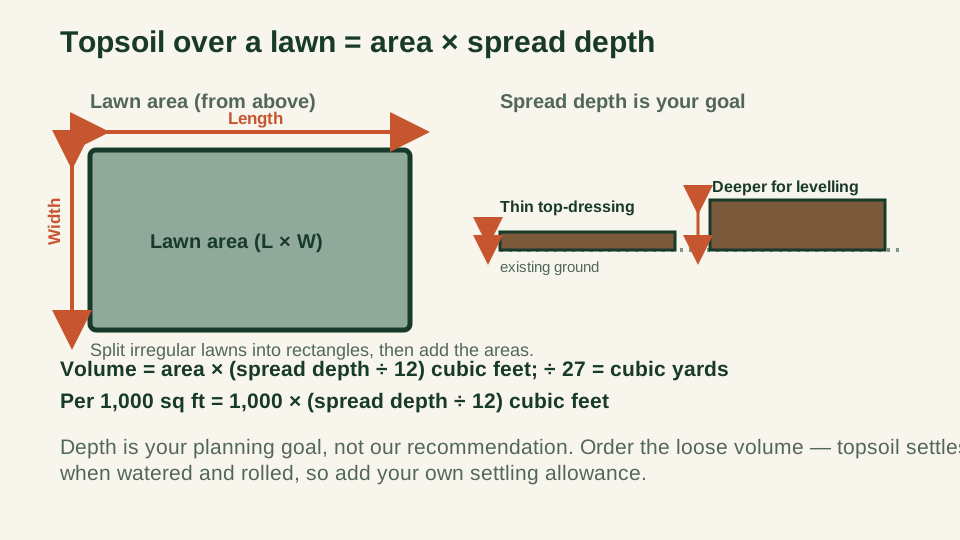
Topsoil spread over open ground is a thin, even layer, so the volume is the area × the spread depth. Convert the depth from inches to feet (divide by 12), multiply by the area in square feet, and divide by 27 for cubic yards — the unit topsoil is usually delivered in.
This is a different job from filling a raised bed (a deep container) and from cut-and-fill grading (moving earth to change the shape of the ground). If you are reshaping a slope, use the land-grading guide instead.
The spread depth is your goal, not our recommendation
How thick to spread is your decision. A thin top-dressing over an existing lawn is a fraction of an inch; levelling dips or building a seedbed for a new lawn is deeper. Enter the depth your plan or goal calls for — this guide recommends none and simply does the arithmetic.
Spread depth is an average. Over uneven ground the real depth varies, which the next sections handle.
Measure the area, then convert
Measure the lawn's length and width in feet. Split an irregular lawn into rectangles, calculate each, and add the areas — the same method as any square-footage measurement. Then apply your spread depth.
Volume = area × (spread depth ÷ 12) cubic feet; divide by 27 for cubic yards. For example, 2 inches over a 40 ft × 25 ft (1,000 sq ft) area is 1,000 × (2 ÷ 12) = 166.7 cubic feet ≈ 6.17 cubic yards.
Topsoil per 1,000 square feet
Top-dressing is often quoted per 1,000 square feet. Multiply the per-1,000 figure below by (your area ÷ 1,000). The depths are planning goals, not recommendations.
| Spread depth | Cubic feet per 1,000 sq ft | Cubic yards per 1,000 sq ft |
|---|---|---|
| 1/4 in | 20.8 | 0.77 |
| 1/2 in | 41.7 | 1.54 |
| 1 in | 83.3 | 3.09 |
| 2 in | 166.7 | 6.17 |
| 3 in | 250.0 | 9.26 |
Cubic feet per 1,000 = 1,000 × (depth in inches ÷ 12). Multiply by (your area ÷ 1,000). Order loose volume; topsoil settles when watered and rolled.
Uneven ground and low spots
For levelling, the spread depth is not uniform: high areas need little or none and low areas need more. Estimate an average depth across the area, or measure the low spots separately and add their fill to a thin overall top-dressing.
If the ground genuinely needs reshaping — cutting high areas and filling low ones — that is earthwork, and the land-grading guide's grid method measures cut and fill separately. Thin topsoil spreading assumes the ground is already roughly the shape you want.
Order loose volume — topsoil settles
Topsoil is measured and delivered loose but settles once it is watered and rolled, so the finished depth is a little less than the loose spread depth. Order the loose volume and add a settling allowance if you want the finished depth to hold — the amount is your judgement, entered as the calculator's wastage allowance.
Avoid heavy compaction of topsoil: federal soil guidance treats over-compaction as a loss of soil quality, so the aim is a firm, not a rolled-hard, surface. Order for the loose spread, not a compacted one.
Worked example and worksheet
New lawn area 40 ft × 25 ft = 1,000 sq ft at a 2-inch goal depth: 1,000 × (2 ÷ 12) = 166.7 cubic feet ≈ 6.17 cubic yards. A 1/2-inch top-dressing over the same area is 1,000 × (0.5 ÷ 12) = 41.7 cubic feet ≈ 1.54 cubic yards. Add your settling allowance, then order in cubic yards or bags.
- Lawn area in square feet (split irregular shapes into rectangles and add).
- Spread depth goal (in), converted to feet — an average if the ground is uneven.
- Any low spots measured separately for extra fill.
- Volume in cubic feet, then cubic yards (÷ 27) or bags (÷ bag size, rounded up).
- Settling allowance if you want the finished depth to hold (your figure).
- Confirmation this is spreading, not cut-and-fill grading (see the land-grading guide if reshaping).
- Supplier density or bag size confirmed; supplier price entered for a cost estimate.
Same project
Related measurement guides
Sources and limits
Check the project-specific details
- NIST unit definitions — Exact foot and cubic-yard definitions used in the volume and per-1,000-square-foot conversions.
- USDA NRCS, Protecting Urban Soil Quality — Federal guidance treating topsoil placement depth as a specified, inspected quantity, and the Web Soil Survey for site soil data. This guide gives no agronomic recommendation.
Review status: Formulas and conversions covered by automated tests; measurement practice pending human trade review.
This guide supports planning only. It does not specify structural design, code compliance, or a supplier quotation.